Car hauling reference
Car hauler capacity by trailer: vehicles and weights
By Mike Shelton, truck dispatcher, 15 years in trucking · Reviewed and updated · How we check facts
Capacity by trailer type, from the makers
| Trailer | Vehicles | Spec note | Source |
|---|---|---|---|
| 3-car gooseneck, 43 ft (Kaufman) | 3 | Small cars only; 14,800 lb GVWR | Kaufman Trailers product pageChecked October 2026 |
| 3-car wedge, 50 ft (Texas Pride) | 3 | 13,820 lb payload; 21,000 lb GVWR | Texas Pride Trailers product pageChecked October 2026 |
| 6-car enclosed (Intercity Lines) | 6 | Full load on a 6-car enclosed carrier | Intercity Lines owner-operator pageChecked October 2026 |
| Stinger, CX-09LSFA (Cottrell) | 9 to 10 | Depends on the vehicle combination | Cottrell Trailers model pagesChecked October 2026 |
| Stinger, CX-11HCS / CX-7MST (Cottrell) | 10 to 11 | Depends on trailer and head ramp combination | Cottrell Trailers model pagesChecked October 2026 |
These are published figures for specific models, checked October 2026, not limits for every trailer of the type. Capacity varies by trailer and by the vehicles on it; check the maker's spec for the trailer you run. Cottrell, for example, also builds 3-car, 3.5-car and 4-car head ramp units for home delivery and an 80 ft enclosed trailer, and states its stinger counts "depending on the combination." Cottrell Trailers model pagesChecked October 2026
The trailer types, briefly
- Bumper-pull and gooseneck flat car haulers: one or two vehicles on a flat deck with ramps; common behind pickups for local and dealer work.
- Wedge trailers: a gooseneck whose deck slopes down toward the rear, carrying three or four cars nose to tail, sometimes with one riding partly over the gooseneck. The usual start for small car hauling businesses.
- Home delivery and head ramp units: short multi-deck units, such as Cottrell's 3, 3.5 and 4-car models, built to reach residential streets and dealers.
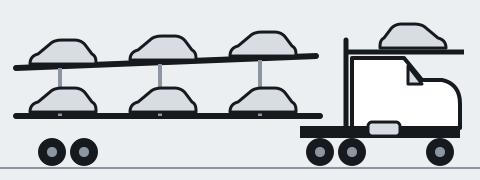
- High-mount trailers: two-level trailers coupled over the tractor's drive axles, with a headrack over the cab carrying more vehicles.
- Stingers: the fifth wheel sits behind the drive axles, so the trailer and the tractor's deck form one long load; the highest counts in the trade.
- Enclosed carriers: soft-side or hard-side boxes, single or two-level, often with liftgates for low cars; fewer vehicles at higher prices per car.
How to read the table
A car count assumes a mix of vehicles that fit the decks. Swap a sedan for a crew-cab pickup and you may lose a position, because the pickup is longer, taller and heavier. Makers publish a range for that reason. Kaufman says it plainly: its 43 ft gooseneck hauls three small cars, not three medium or large ones, and is mainly a truck and van hauler. Kaufman Trailers product pageChecked October 2026
On bigger rigs, length sets the count. Federal rules stop states from setting overall length limits below 65 ft for traditional auto transporters or 75 ft for stinger-steered ones, not counting cargo overhang. 23 CFR 658.13(e)Checked October 2026 Putting the fifth wheel behind the drive axles lets cars ride over the cab, which is how stingers reach 9 to 11 vehicles.
Weights: payload beats deck space on small trailers
On a gooseneck, the trailer's payload usually runs out before its deck does. Texas Pride's 50 ft wedge is rated 21,000 lb GVWR, weighs 7,180 lb empty and carries a net payload of 13,820 lb. Texas Pride Trailers product pageChecked October 2026
Payload math on a 3-car wedge
EXAMPLE| Vehicle | EXAMPLE weight | Fit by weight | Three of them |
|---|---|---|---|
| Compact sedan | 3,000 lb | 4 | Within payload |
| Midsize SUV | 4,500 lb | 3 | Within payload |
| Full-size pickup | 5,500 lb | 2 | Over by 2,680 lb |
Three compact sedans fit with room to spare; three full-size pickups put the trailer 2,680 lb over its rating. A mixed load of two sedans and one pickup at 11,500 lb works. On full-size stingers, weight is rarely the limit, because a tractor-trailer can gross up to 80,000 lb on the Interstate 23 CFR 658.17(b)Checked October 2026; height and length are.
A mixed stinger load
EXAMPLEA dispatcher plans a stinger rated for 9 to 10 vehicles. The order has six sedans, two midsize SUVs and two full-size crew-cab pickups. The pickups are too tall for the top deck and too long for the head ramp, so they go on the lower trailer positions, each using more length than a sedan. The SUVs take two more lower slots. That leaves upper positions for the sedans, but only five fit after the pickups' extra length. The truck leaves with 9 vehicles, not 10, and the tenth car is booked on the next trip. That is what "depending on the combination" means in practice.
Height: the other cap on a load
There is no federal height limit; each state sets its own. GAO-15-236Checked October 2026 Pennsylvania caps vehicles at 13 ft 6 in without a permit PennDOT (75 Pa.C.S. 4922)Checked October 2026, while California allows 14 ft. Cal. Vehicle Code 35250 (via Caltrans legal truck access page)Checked October 2026 High-mount and stinger rigs put cars on top decks close to those numbers, so tall SUVs and pickups go on lower positions. A load that is legal in one state can be too tall for the next, which is why dispatchers ask for every vehicle's height, not just its model.
On the job: loading to capacity
- List every vehicle's length, height and weight before you plan the deck.
- Put the heaviest vehicles over the axles and the tallest on the lowest positions.
- Load in reverse delivery order, so the first drop comes off without moving others.
- Strap every vehicle with at least two tiedowns, front and rear. 49 CFR 393.128Checked October 2026
- Measure the finished height and check it against every state on the route.
License follows the ratings: a pickup and gooseneck combination rated 26,001 lb or more, towing a trailer rated over 10,000 lb, needs a Class A CDL. 49 CFR 383.5Checked October 2026 A 21,000 lb trailer behind a heavy dually crosses that line on ratings alone.
Capacity and revenue
Capacity matters because car haulers are paid per vehicle and pay costs per mile. A stinger running 9 of 10 positions full earns 90% of its possible revenue on the same fuel, tolls and hours as a full load. A 3-car wedge with one empty slot loses a third of its revenue for the trip. That is why booking a car hauler is mostly about filling the last positions along one route, and why capacity on paper is less important than capacity you can fill.
Capacity mistakes that cost money
- Counting positions without checking the vehicle mix against the maker's range.
- Loading to the deck while ignoring the trailer's payload rating.
- Putting a tall SUV on a top deck and finding out at the first low bridge or state line.
- Booking a pickup on a trailer the maker builds for small cars.
- Forgetting that the tow vehicle's rating, not just the trailer's, sets the license and the legal load.
Methodology
Capacities come from each maker's own product page (Cottrell, Kaufman, Texas Pride) and one carrier's published owner-operator requirements (Intercity Lines), checked October 2026. Where a maker gives a range, we show the range. Vehicle weights in the payload table are EXAMPLE values, not data. We recheck the specs every year and add makers as we verify their published figures.
More on the rigs in car hauler trailer types and hauling trailers. For what a full trailer earns, see how much car haulers make and car hauling statistics, or run a load through the car hauler load profit calculator. We no longer dispatch car haulers; for the rigs we book, start at GearLoads.
Car hauler capacity by trailer FAQ
01How many cars can a car hauler carry?
It depends on the trailer and the vehicles. Makers' specs run from 3 cars on a gooseneck wedge to 9 to 11 vehicles on a full stinger: Cottrell lists 9 to 10 for its CX-09LSFA and up to 10 or 11 for its CX-11HCS and CX-7MST. Enclosed carriers move fewer, such as 6 on Intercity Lines' enclosed trailers.
02How much weight can a 3-car hauler carry?
Read the trailer's payload, not just the car count. Texas Pride's 50 ft three-car wedge has a net payload of 13,820 lb on a 21,000 lb GVWR. That fits three compact sedans at about 3,000 lb each, but only two full-size pickups at about 5,500 lb. Kaufman's 43 ft gooseneck, at 14,800 lb GVWR, is built for three small cars.
03Do you need a CDL for a 3-car hauler?
Usually, once loaded. A pickup and a gooseneck rated over 10,000 lb need a Class A CDL when the combination is rated 26,001 lb or more. A 21,000 lb GVWR trailer behind a dually rated around 14,000 lb crosses that line on ratings alone, whatever the cars weigh. Check both rating plates, not just the scale ticket.
04How long can a car hauler be?
Federal rules stop states from setting an overall length limit below 65 ft for traditional auto transporters, with the fifth wheel over the tractor's rear axles, or below 75 ft for stinger-steered ones, not counting front and rear cargo overhang. That extra length is why stingers fit more cars. States can allow more and set their own overhang rules.
Mike Shelton, Truck dispatcher
Mike Shelton is a truck dispatcher with 15 years of experience in trucking. He writes and reviews the GearLoads hauling guides, calculators, factoring and DOT compliance pages, and checks every rule against its official source.