Grain hauling
Grain truck and grain hauling
Hopper bottoms, bushels, rules and rates.
By Mike Shelton, truck dispatcher, 15 years in trucking · Reviewed and updated · How we check facts
Grain trucks: the rig card
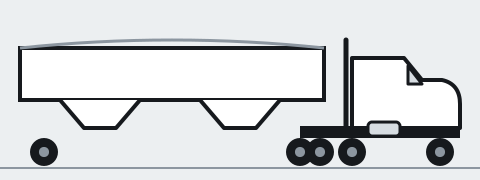
- What it is: a hopper bottom trailer, usually aluminum, with two or three sloped hoppers that empty through gates in the floor; or a straight truck with a dump box.
- What it hauls: corn, soybeans, wheat, sorghum and other grains, plus feed, fertilizer and some dry bulk.
- License: Class A for a tractor-trailer 49 CFR 383.5Checked October 2026; Class B for a straight truck rated 26,001 lb or more. 49 CFR 383.5Checked October 2026
- How it pays: per bushel, ton, load, hour or loaded mile, depending on the run.
Hopper bottoms load from an auger or a grain cart in the field, or from a spout at a bin or elevator, and unload by opening the gates over a pit. A roll tarp keeps grain in and rain out. See hopper gates for how unloading works.
Straight grain trucks vs hopper bottoms
Farm straight trucks with a grain box and hoist are built for short, fast trips: field to bin, bin to the local elevator. They turn tight in farmyards and load easily from a grain cart, but carry far fewer bushels. Tractors with hopper bottoms carry roughly twice as much or more and handle long runs to processors and terminals, at the cost of a bigger, heavier rig that needs a Class A driver. Many farms run both: straight trucks during harvest and hired hoppers for marketing grain later.
Bushels per load: the weight math
Grain is dense, so weight sets the load before the trailer fills. On the Interstate the gross limit is 80,000 lb unless the bridge formula sets less 23 CFR 658.17(b)Checked October 2026, and axle groups must pass the bridge formula too. 23 CFR 658.17(e); FHWA Bridge Formula WeightsChecked October 2026 Standard bushel weights do the rest. USDA Census of Agriculture appendix, weights and measures (NASS)Checked October 2026
| Grain | lb per bushel | Bushels per load |
|---|---|---|
| Corn | 56 | 892 |
| Sorghum | 56 | 892 |
| Soybeans | 60 | 833 |
| Wheat | 60 | 833 |
Wet grain weighs more per bushel than dry, so early-harvest loads can hit the limit sooner. Some states grant harvest weight allowances on their own roads; check before you load past 80,000. Run your axle spacing through the federal bridge formula calculator.
Hours rules during harvest
Federal hours-of-service rules don't apply, during the planting and harvest periods each state sets, to drivers hauling agricultural commodities within 150 air-miles of the source. 49 CFR 395.1(k)Checked October 2026 That covers most field-to-elevator hauling in season. Outside those periods or farther away, the normal limits and ELD rules apply. Long harvest days still wear drivers down, so plan rest even when the rule doesn't require it.
Grain hauling seasons
Harvest moves grain fast: winter wheat in June and July on the southern Plains, spring wheat in August and September up north, and soybeans and corn from late September through November in the Corn Belt, by USDA's usual dates. USDA NASS, Field Crops Usual Planting and Harvesting Dates (Oct 2010)Checked October 2026 The rest of the year, stored grain moves from bins and elevators to processors, feedlots, ethanol plants and export terminals on buyers' schedules. See the full grain hauling season calendar by state.
The volume is enormous: 17.02 billion bushels of corn, 4.26 billion of soybeans and 1.98 billion of wheat in 2025. USDA NASS Crop Production 2025 Summary (January 2026)Checked October 2026 Most of it rides a truck at least once.
Grain hauling rates
Custom grain hauling rates are set locally and by season. During harvest, short field-to-bin or field-to-elevator runs often pay per bushel or per hour. Longer hauls to a processor or a river terminal pay per loaded mile or per ton.
Per-bushel harvest run
EXAMPLEA hopper hauls corn 25 miles from a field to an elevator at an assumed 18 cents a bushel. Each load carries 890 bushels, paying $160. A round trip, with 45 minutes in the elevator line, takes about two hours, so the truck can run five loads in a 10-hour day: $800. If the line stretches to two hours at peak harvest, the same day fits three loads and pays $480. The rate per bushel didn't change; the line did.
Loading and unloading safely
Most grain hauling injuries happen around the load, not on the road. Stay clear of augers and power takeoff shafts while they run, keep guards in place, and never climb into a hopper or onto grain to free a plug while gates are open or grain is moving, because flowing grain can pull a person under in seconds. Open gates slowly over the pit, wear a dust mask in heavy grain dust, and use the catwalk and handholds when you roll the tarp.
Mistakes that cost grain haulers
- Filling by volume instead of weight and scaling heavy at the elevator.
- Leaving the tarp open and losing grain, or soaking the load in rain.
- Pricing harvest runs per mile when the time goes to elevator lines.
- Hauling feed or food grain after fertilizer without cleaning the trailer.
- Driving past the 150 air-mile radius and forgetting that the hours rules apply again.
Grain hauling companies and owner-operators
Grain is hauled by farmers with their own trucks, custom harvest crews who follow the wheat north, local grain trucking companies working for elevators and co-ops, and owner-operators who lease to them or run under their own authority. Owner operator grain hauling works best with a mix: harvest work in the fall and summer, and contracted runs of stored grain, feed or fertilizer the rest of the year. Shippers of grain for food and feed may also ask about trailer cleaning and previous loads, since food transport rules cover vehicle sanitation. 21 CFR Part 1, Subpart O; FDA FSMA rule pageChecked October 2026
Getting into grain hauling
- Get the CDL that matches your truck: Class A for a tractor and hopper.
- Buy or lease a hopper bottom with gates, tarp and floor in good condition.
- Weigh the rig empty so you know your real payload in bushels.
- Line up harvest work with elevators, co-ops and custom harvesters before the season.
- Plan the off-season: stored grain, feed, fertilizer and other dry bulk.
Our desk plans loads around the seasons, so your hopper isn't parked when harvest ends. For owner-operators running more than one kind of rig, see dispatch for owner-operators. Related reading: long haul trucks, logging trucks, heavy haul trucking and hauling, explained by rig. More at GearLoads.
Grain truck FAQ
01How many bushels does a grain truck hold?
Weight decides it on the highway. A tractor and hopper bottom weighing 30,000 lb empty can carry about 50,000 lb under an 80,000 lb gross: roughly 890 bushels of corn at 56 lb a bushel, or 830 of soybeans or wheat at 60 lb. Straight farm trucks carry far less. Check your own empty weight on a certified scale.
02Do you need a CDL to haul grain?
Usually. A tractor and hopper bottom needs a Class A CDL, and a straight grain truck rated 26,001 lb or more needs Class B. Some states have farm exemptions for farmers hauling their own grain close to home, but for-hire grain hauling needs the license that matches the truck's ratings. Check your state licensing agency for the farm rules.
03How are grain hauling rates set?
Local harvest hauling, field to bin or elevator, is often paid per bushel, per load or per hour. Longer runs to processors, ethanol plants, feedlots and river terminals pay per loaded mile or per ton. Elevator lines, wet fields and short runs all eat into hourly earnings, so experienced grain haulers price the waiting, not just the miles.
04What do grain trucking companies look for in drivers?
A Class A CDL, a clean record, comfort with long harvest days and patience at elevators, plus the ability to work hopper gates, tarps and augers safely. Owner-operators also need a hopper bottom in good shape, a tarp that seals, and a plan for the months between harvests, when stored grain moves on schedules set by buyers.
Mike Shelton, Truck dispatcher
Mike Shelton is a truck dispatcher with 15 years of experience in trucking. He writes and reviews the GearLoads hauling guides, calculators, factoring and DOT compliance pages, and checks every rule against its official source.