Livestock reference
How many cattle fit on a trailer? Loading chart by weight and trailer size
By Mike Shelton, truck dispatcher, 15 years in trucking · Reviewed and updated · How we check facts
Cattle loading chart by trailer size
| Floor (L x W) | 400 lb | 600 lb | 800 lb | 1,000 lb | 1,200 lb | 1,400 lb |
|---|---|---|---|---|---|---|
| 16 x 6 | 18 | 12 | 9 | 7 | 6 | 6 |
| 20 x 6 | 23 | 15 | 12 | 9 | 8 | 7 |
| 24 x 6 | 28 | 18 | 14 | 11 | 9 | 9 |
| 28 x 6 | 32 | 22 | 16 | 13 | 11 | 10 |
| 32 x 6 | 37 | 25 | 18 | 15 | 12 | 11 |
| 20 x 7 | 27 | 18 | 13 | 11 | 9 | 8 |
| 24 x 7 | 32 | 22 | 16 | 13 | 11 | 10 |
| 28 x 7 | 38 | 25 | 19 | 15 | 13 | 12 |
| 32 x 7 | 43 | 29 | 22 | 17 | 14 | 13 |
The table above is a selection; the full extension chart covers 14 to 34 ft floors, 6 and 7 ft wide, from 400 to 1,700 lb. Mississippi State University Extension P2797, Transporting Beef Cattle by Road (Aug 2025), Table 1Checked October 2026 The counts are maximums for typical feeder cattle. Mature or fat cattle take more room for the same weight, so the publication notes fewer of them fit.
Square feet per head, by weight
To use the chart on any trailer, including pots, turn it into floor area per animal. Dividing the 34 by 7 ft floor (238 sq ft) by the recommended head count gives these areas:
| Average weight | 400 | 600 | 800 | 1,000 | 1,200 | 1,400 | 1,600 |
|---|---|---|---|---|---|---|---|
| Sq ft per head | 5.2 | 7.7 | 10.3 | 13.2 | 15.9 | 17.0 | 19.8 |
Use them as a starting point and adjust for horns, condition, weather and how the cattle handle.
Reading the chart for sizes in between
Real trailers and real cattle rarely match a row exactly. When the floor or the average weight falls between two figures, work out the area per head for the weight and divide your floor area by it, then round down, never up. A 22 ft trailer that is 6 ft 8 in wide is not a 7 ft trailer. Measure inside the trailer, wall to wall and gate to gate, because the outside length includes the gooseneck and the nose, which cattle don't stand on unless it is floored and gated for them.
Stock trailers, goosenecks and pots
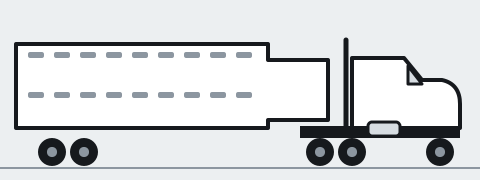
Bumper-pull and gooseneck stock trailers are the ranch workhorses, usually 6 or 7 ft wide and 14 to 32 ft long, with one floor and a center gate or two. The extension chart is written for them. Cattle pots, the semi trailers commercial haulers pull, have a drop center between the axles and two decks front and rear, so the load splits into four or more compartments with different floor areas and headroom. Possum-belly and straight-deck livestock trailers vary again. On any of them, the method is the same: floor area divided by area per head, compartment by compartment.
Cattle class changes the count
- Feeder cattle: the chart's baseline; uniform weights load the cleanest.
- Finished and mature cattle: bigger frames and more fill take more room than the same weight of feeders, so load fewer.
- Bulls: haul them in their own compartment, away from cows and steers.
- Cows with calves: keep pairs together but give calves room so they aren't stepped on.
- Mixed weights: sort heavier cattle into the front compartments and lighter ones to the rear.
Pot trailers: loading compartment by compartment
Semi cattle pots split the load into compartments on two decks, the nose, the upper and lower decks and the belly, each with its own floor area and headroom. Load each one on its own: measure the floor, multiply length by width and divide by the area per head. Heavier cattle go toward the front, and different groups go in separate compartments. Mississippi State University Extension P2797, Transporting Beef Cattle by Road (Aug 2025), Table 1Checked October 2026
One compartment, worked out
EXAMPLEA pot compartment measures 15 ft by 7 ft 6 in inside, 112.5 sq ft. Cattle average 850 lb, so use about 11 sq ft per head, between the 800 and 900 lb figures. 112.5 ÷ 11 = 10.2, so 10 head. If they are horned, cut 5% to 9. If it will be 95 F at the sale barn, load 8 and let the rest ride in the next compartment or the next truck. Repeat for each compartment and add up the head and the weight. Our cattle trailer loading calculator does this compartment math for you.
Cold and wind
Cold is a hazard too. The extension guide treats a wind chill below 0 F as extreme cold and wind, and notes the hottest part of a summer day typically runs from 11 a.m. to 4 p.m. Mississippi State University Extension P2797, Transporting Beef Cattle by Road (Aug 2025), Table 1Checked October 2026 In extreme cold, close or plug the trailer's side openings as the hauler's practice and the weather call for, keep cattle dry, and avoid long waits with the truck parked in the wind. Wet cattle in freezing wind lose condition fast.
Why the count matters
- Too many: cattle that go down can't get up and get trampled; bruising and heat stress rise.
- Too few: cattle have room to shift and fall when the truck brakes or turns, which also causes injuries.
- Weight: a full pot of finished cattle can push the truck to its 80,000 lb Interstate limit 23 CFR 658.17(b)Checked October 2026; check the scale ticket.
- Time: animals generally can't be confined more than 28 consecutive hours without being unloaded for feed, water and rest 49 U.S.C. 80502(a)Checked October 2026, and the rest must last at least 5 hours. 49 U.S.C. 80502(a)-(b)Checked October 2026
On the job: loading checklist
- Get the head count and average weight from the shipper before you arrive.
- Measure each compartment's floor, not the trailer's outside length.
- Work out head per compartment from the area per head, then adjust for horns and heat.
- Load heavier cattle forward and keep groups apart.
- Close each gate as the compartment fills so cattle can't crowd back.
- Weigh when you can, and check the cattle at your first stop.
Who decides the count at the sale barn
The shipper knows the cattle; the hauler knows the trailer and the road. At a sale barn or a ranch alley, there is often pressure to fit a few extra head so a load doesn't have to be split. The hauler is the one driving the cattle through the heat of the afternoon and the hard stops, so the hauler should make the final call. Agree on the head count and the average weight when the load is booked, write it on the paperwork, and if the cattle turn out heavier than promised, say so before the gate closes rather than after something goes wrong on the road.
Common loading mistakes
- Using the trailer's outside length instead of the floor the cattle stand on.
- Loading to the chart on a 95 F afternoon.
- Filling the front compartments and leaving the rear half empty, which shifts weight and lets cattle fall.
- Mixing bulls, cows and calves in one compartment.
- Guessing the average weight instead of asking for the sale or scale weight.
Methodology
Head counts are copied from Table 1 of Mississippi State University Extension Publication P2797, "Transporting Beef Cattle by Road," August 2025. Square feet per head are our division of that table's largest floor by its head counts. The pot compartment math is an EXAMPLE of applying those areas. We review this chart every year and when the publication changes.
For the work itself, read our cattle hauling guide and cattle hauling rates, time your run with the 28-hour law timer, and see livestock dispatch or the GearLoads home page.
How many cattle fit on a trailer FAQ
01How many cows fit in a 24 ft stock trailer?
On a 24 by 7 ft floor, Mississippi State Extension's loading chart recommends a maximum of about 16 head at 800 lb, 13 at 1,000 lb and 11 at 1,200 lb. A 6 ft wide trailer of the same length holds fewer: 14, 11 and 9. Load about 5% fewer if the cattle have horns, and fewer still in hot weather.
02How many calves fit on a trailer?
Light calves fit many more per foot. The same chart puts a 24 by 7 ft floor at about 32 head of 400 lb calves and 26 at 500 lb. Calves still need room to stand and keep their footing, and weaned calves under stress handle heat poorly, so haul fewer on hot days and partition groups so they can't pile into one end.
03How many cattle fit on a semi pot trailer?
It depends on the pot's deck layout and the cattle's weight, so work it out compartment by compartment. Measure each compartment's floor, multiply length by width, and divide by the floor area per head for the weight class: about 13 sq ft per head for 1,000 lb cattle on the extension chart. Then check the truck's gross and axle weights.
04How many pigs fit in a semi trailer?
Hogs have their own space rules, set by weight, season and trailer type, and US pork producers follow the National Pork Board's Transport Quality Assurance program for them. Use that program's space table for the hogs you haul rather than cattle figures, and reduce the load in hot, humid weather when hogs are most at risk.
Mike Shelton, Truck dispatcher
Mike Shelton is a truck dispatcher with 15 years of experience in trucking. He writes and reviews the GearLoads hauling guides, calculators, factoring and DOT compliance pages, and checks every rule against its official source.